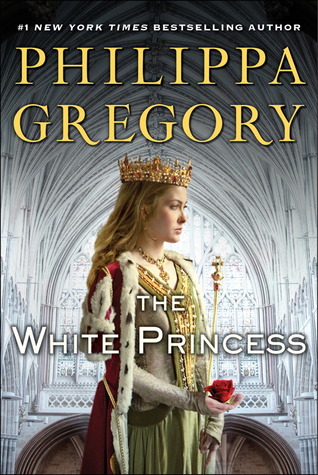
The White Princess is the tale of Elizabeth, the daughter of The White Queen and sister to the Princes in the Tower. At the conclusion of the Cousins' War, when Henry Tudor takes the throne, Henry also takes Elizabeth as his wife. The pair is less than pleased to be wed, but they know it is necessary to unite the houses of York and Lancaster, and it is most necessary for there to be a whole slew of Tudor Princes, else Henry won the war for nothing. Henry struggles to hold the throne, hold the love of England, and gain the love of his wife. Things seem to be going well, but then there is "the boy." The boy who may very well be Prince Richard of York, Elizabeth's brother. The boy with a better claim to the throne then Henry.
Philippa Gregory is very upfront with the fact that this is fiction about a mystery, and we don't know the truth of the Princes in the Tower or their death. She is only presenting a case of what might have happened, a story strung together by the facts we do know. Loving Gregory's work as I do, I tend to believe her story, that it is possible things could have happened this way.
As with all historical fiction, we already know how the story ends. There isn't going to be a big twist. Yet The White Princess is still an enjoyable read. It's not my favorite Gregory work because Elizabeth wasn't as complex a character as her mother or grandmother (I also felt the book ended too soon). She is, however, still a unique character. Same as Henry. Both of them are very realistic and make choices I feel to be true to character. Reading The White Princess also helps one understand Henry VIII better because one comes to understand his heritage. I thoroughly enjoyed and recommend this book.
Wednesday, August 28, 2013
The White Princess
Sunday, May 19, 2013
The Genesis Secret
Tom Knox's Genesis Secret tells the suspenseful yet intelligent tale of reporter Robert Luttrell. Sent on a supposedly simple assignment about the excavation of Gobekli Tepe in Kurdish Turkey, the oldest remains of human civilization and apparent Garden of Eden. Rob is quickly drawn in to the mystery of Gobekli Tepe, why the locals are resisting the dig, and, ultimately, the death of the lead archaeologist. Back in the UK, a string of brutal murders are being committed and investigated by the Scotland Yard, especially Detective Forrester. Eventually, a connection is made and Forrester and Luttrell must work together to discover the Genesis secret and, more importantly, catch the crazed murderer.
The Genesis Secret is a fairly intense read, not one you can necessarily read at the beach or with distractions around, especially at the end. I mean, James Joyce is referenced! It's a good book; though slow to start, once it all starts to come together it gets hard to put down. However, it is rather violent and grotesque and the language is, at times, obscene and responsive to the violence. The characters attempt to be real and relatable, but fall short. I was more captivated by the story line and desire to solve the mystery than the fate of the characters. I enjoyed it, but I didn't love it. 3 & 1/2 stars.
Friday, March 8, 2013
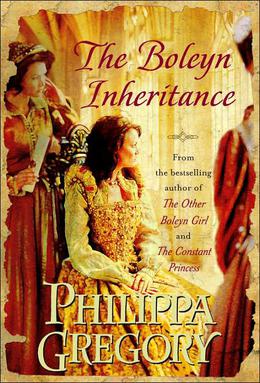
The Boleyn Inheritance
Philippa Gregory's The Boleyn Inheritance picks up where The Other Boleyn Girl left off. Well, skipping the short marriage of Jane Seymour and the birth of her son, Edward. The Boleyn Inheritance shows the changes that have come about because of the interfering Boleyn's and their cousins the Howards. We read about the marriage and annulment of Henry VIII to Anne of Cleves as well as the consequent marriage to Anne Boleyn's much younger cousin, and my second favorite wife, Kitty Howard.
I enjoyed The Boleyn Inheritance, but it's a little more like short stories put together than Gregory's other works. I would have liked her to delve more into the characters and given these wives their own novels as well, although I can understand why she chose not to. Writing takes much longer than reading, and Gregory prides herself on doing actual research. This could have gotten very tedious. Or maybe there wasn't enough truth out there, just rumors or unreliable accounts. or perhaps she just had other ideas she was anxious to get to work on. So I understand why the book may be set up like it is, but it made it harder to get into the work and get to know the characters. Regardless, it's an enjoyable historical fiction. If you like Henry VIII's life as I do, give it a go!
Wednesday, February 20, 2013
The Other Boleyn Girl
Monday, February 11, 2013
The Constant Princess
My first Philippa Gregory book ever was The Constant Princess, the tale of Catherine of Aragon before she married Henry VIII. It tells of Catherine as Catalina, the Infanta of Spain, only to become Catherine upon her marriage to Arthur, Prince of Wales. Arthur, Henry's older brother who was to become king. Arthur, the prince who became sickly and died too soon.
Catherine of Aragon is my least favorite of Henry VIII's wives [yes, I have them ranked. ish. Don't judge.], or at least bottom two. It's like a feel bad for her, but I don't feel her the way I feel some of the others. I don't believe this is due to Gregory's writing, but just Catherine herself.
The Constant Princess does introduce us to a new side of Catherine, a younger Catherine. She is a desperate widow, heartbroken by Arthur's death, abandoned by her father, abandoned by England. And so, she must take her fate into her own hands: she must fight for what she wants, she must fight to become the Queen of England, as she was meant to be.
If you're interested in Henry VIII, Historical Fiction, or Philippa Gregory at all, this book is worth the read. You'll like it.
Tuesday, January 8, 2013
Virgin Earth
Virgin Earth, the free-standing sequel to Earthly Joys by Philippa Gregory, tells the story of John's son, John. The two men have never seen eye-to-eye, especially in the turmoil of England, but they have been able to make it work because they need to, because they are both gardeners for the king. And so John the younger goes to Virginia (remember, this is pre-United States of America. This is early Jamestown days) to collect new plants and escape the pain of his wife's death. While there, he falls in love with his young Powhatan guide. But the story doesn't end there! John travels back to England, then back to Virginia, and back to England again. Similar to Earthly Joys, yet slightly more enjoyable, there are nice aspects to Virgin Earth. It's neat to learn about the way of the Powhatan and the changes England goes through prior to and during it's civil war. But it has the same problems as Earthly Joys, too. I didn't connect with this John, either. It was like Philippa was trying to cover too much ground and couldn't get into enough depth for me to enjoy it. I'm not sure that I recommend this book, but it really wasn't a terrible read. I just expect more from Ms Gregory and didn't love Virgin Earth.
Earthly Joys
Well, Philippa, ya win some, you lose some. And you just didn't win me over with Earthy Joys, either time I've read it. The historical backdrop of the switch from the Tudors to the Stuarts was interesting, as was the tulip crash. And sometimes I even liked John (the main character), but I didn't always get why I was reading about him. Nothing was pulling me forward into the story. it covered almost John's whole life, instead of being a story about X,Y,Z. There wasn't necessarily a conflict, or even a climax to the novel. I couldn't draw this out as a plot line diagram, as they have students do. It was a long, long novel and didn't seem like one unified story. Maybe I just didn't get the love story between John and his "masters" well enough. Maybe I didn't get his love for his plants. So, I don't really recommend this, unless you're like me and determined to read all of Philippa Gregory's books so you can honestly say she's your favorite author (I need to be researched and legit, ya'll. and I have to read everything!!) or a lover of botany. And if you do choose to read it: warning & slight spoiler -- there is one gay sex scene.
Friday, July 27, 2012
The First Princess of Wales
Monday, June 18, 2012
The Irish Princess
Karen Harper's The Irish Princess introduced me to Elizabeth Fitzgerald, the uncrowned Irish Princess of Tudor times and rule. The Fitzgeralds and Henry VIII don't exactly get along, and that leads to quite a few visits to the Tower of London for the Fitzgerald men. Elizabeth, or Gera, is also forced to relocate to London so Henry VIII and his men can keep an eye on her and her family.
I enjoyed The Irish Princess; it was nice to be introduced to a new character and storyline. I feel like Harper really captured that Irish "feel" that Gera needed, though I'm no expert in that area. Gera was a fun character to read about; she's stubborn, outspoken, and reminded me of what I've read of Elizabeth I, which makes sense because they were close friends. It was also weird that Henry VIII was the bad guy, I usually like him, or feel sorry for him at any rate!
Most of the story was true to history, Harper obviously took some liberties, but Gera was a real person and her relationships were also true. It was an enjoyable read, but at times I found myself wishing that Philippa Gregory had written it, because it got a little dry and felt a little long. I also wish Harper had included a family tree in the front of the book, like Gregory always does. Overall, though, it was a pretty good book and I recommend it to my fellow historical fiction lovers!
Wednesday, June 6, 2012
The Red Queen
Chronologically the third novel of the Cousins' War by Philippa Gregory, The Red Queen finishes out the battles for kingship, as told through the eyes of Margaret Beaufort, the young cousin of Henry VI. The Red Queen is probably my least favorite of the three, because Margaret isn't my favorite person. She's very pious, manipulative, and controlling. She birthed Henry Tudor and pushes him towards the throne, even over her cousin and his son. She conspired for power for many years before her plan came to fruition, and then she continued to be a controlling person, forcing her views on all those surrounding her. Despite my dislike of Margaret, I did enjoy reading The Red Queen because it was so interesting to read the story and learn about that part of history and gives a nice resolution to the Cousins' War.
The White Queen
Tuesday, June 5, 2012
The Lady of the Rivers
Saturday, December 10, 2011
Prince Across the Water
Queen's Own Fool
Sunday, November 20, 2011
Sent
The second book in the missing series, Sent is very much my favorite. It mixes science fiction, historical fiction, and time travel! Plus they travel to just about my favorite time in English history!!
At the end of Found, Jonah and his sister Katherine grab on to their friend Chip and are hurtled back in time to the 1400s. Chip and Alex, who was sent before Chip, are the missing Princes in the Tower. And it's up to these kids to fix time and save the day.
Friday, June 3, 2011
Zelda's Cut
Thursday, May 19, 2011
The Little House
As you know, I absolutely LOVE Philippa Gregory. She could write just about anything at this point, I'm so hooked. I've been trying to get my hands on this book for some time, but it was rather hard to find for a reasonable price. So I finally got my hands on this book, and devoured it in three days.
The Little House is about a woman, Ruth, who, having no family of her own, is completely enveloped by her husband and his parents. They are very controlling, forcing a move to a house down the lane, and taking over the care of the baby -- who they made Ruth give up her career to have. Ruth never wanted the baby, not now at any rate, and suffers from horrible postpartum. The novel discusses her journey through her depression, her relationship with her husband, her baby, and her in-laws. And ends with a nice little twist, which I shall not divulge.
As always, I enjoyed the novel by Gregory, it was the first of her non-historical fictions for me, and I strongly recommend this book, especially to mothers (even though I know nothing about motherhood firsthand). She seems to have quite the grasp on the situation Ruth is dealing with, and presents it in a great way. It is not a light book, but it is easy and enjoyable to read. The characters and the story were easy to relate to, and very realistic. I loved it. Now ya'll go read it!