Showing posts with label Utopia/Dystopia. Show all posts
Wednesday, June 13, 2012
Oryx and Crake
In The Handmaid's Tale, society chose to embrace religion. In Oryx and Crake, science, technology, and evolution are the focus of society. Oryx and Crake begins with Snowman as the narrator and continues to unfold with Snowman in the present and flashbacks to Jimmy and Crake as they grow from young boys into men while science continues to take leaps and bounds developmentally. New animals are created. Society promotes extreme commercialization & sex and pornography are an easily accessible commodity. (reader beware!)
Crake is perfect for this society. He's practically a scientific prodigy. Jimmy, on the other hand, is not. He is much better at art, and there's a little bit of the Science v Art conflict present in the novel. Crake is a manipulative, cunning, and calculating man with pure intentions. Jimmy is his loving, innocent minion.
I really enjoyed reading Oryx and Crake. It's a definite page turner, waiting to see how the two stories meet. It's great! Read on!
The Handmaid's Tale
In the very same class where Feed was required reading, we were also introduced to The Handmaid's Tale. A post-apocalyptic novel of a newly formed utopia, which only brings misery and pain, serving as a dystopia, to many liberals of the 80s, including Offred, the handmaid in the title. In a backlash of feminism, the Republic of Gilead is formed and is based on and governed by Old Testament manner and moral. Anyone who cannot conform to the new ways or lived differently in the past is subject to punishment, exile, or death.
In this reformed government and society, Offred, and women like her, are separated from their families and made to serve as handmaids. They loose their entire person. Even their names are changed. Offred simply means she is of Fred. As in he is her master. She is handmaid to his wife. Handmaids as in the biblical sense. As in Sariah couldn't have a baby, so she offered her handmaiden to Abraham to produce an heir. Many of the women in the new Republic of Gilead are like Sariah and too old too have babies, and many of the babies made, even by the handmaids, are sickly. Offred's job is to make a baby for Fred and his wife. And this is Offred's story.
The Handmaid's Tale is a very interesting book to read. It's crazy to see how a society can take things too far while trying to to do good. I highly recommend this book to those of ya'll who like post-apocalyptic and utopia/dystopian-style.
Tuesday, June 5, 2012
The Hunger Games, Catching Fire, Mockingjay
I don't really have very much to say about Hunger Games itself. I like the novel. I like the whole idea, I mean, who comes up with that?? (although now I can clearly see her influences, but whatever. I maintain that there's no such thing as an original idea so it's not like I find her a copy cat or anything) I like the characters. I like that I never knew if Peeta really had feelings for Katniss or if it was all fake. I like how Collins didn't give the names to many of the other tributes so that killing them didn't feel that different from killing animals, especially for Katniss. I like how intense it was. I like how heartfelt Rue's death was. I like everything. It's a very enthralling book.
Catching Fire is probably my favorite of the three books & I wish they would have spent more time at the games, or more time discussing the games in the book. But it's hard in my mind to distinguish between Catching Fire and Mockingjay to me. They feel like one continuous book, which is fine, but I just have to discuss them together :)
So, here we go. I really like Finnick. He's one of my favorite characters (and I was heartbroken when he died!). But I just get really bugged by Gale! Why is he acting all hurt? He was way more like a brother to Katniss, so I don't get why he's all upset. I understand that it's hard when things change in your life and your best friend starts dating someone else, but really. Get over it, Gale. You're just making Katniss more confused than she needs to be, and protecting everyone is her first priority, not romance.
As far as Katniss, I totally understand. It's hard to choose between the boys and to even understand that you need to choose. But part of growing up means that you can't have both and you can't stay friends. You can call each other friends, but it won't be the same as it was before. Katniss loves Peeta and Gale differently and has different bonds with both of them. Gale understands her pain at her father's death. Peeta was with her at the games. Noone else will ever understand how the games felt to Katniss.
I also feel like Gale didn't really love Katniss to begin with. He feels protective and responsible, he loves her but he isn't in love with her. He says he is, but he's not.
The end of Mockingjay was really rushed to me. Prim's death didn't seem real. Katniss's mourning felt . . . different, somehow. Not quite true to Katniss. I feel like Prim's death was just a suckerpunch. Rue's death makes me super sad. Prim's death feels like something we could discuss over coffee. I do like how Katniss figured out that Coin was just like Snow; took her a little while, though!
I'm not sure how I feel about the ending ending, though. It seems weird, but at the same time, it feels true to Katniss and to Peeta, although I still don't know if they are in love for real, but they do belong together. They need each other. It feels true to the story and to Panem. I'm curious as to how they set up a new government, though,and if it really works.
Overall, I liked the series and was happy with how they ended. What do you think?
Monday, June 4, 2012
The Feed
The year Cass and I first met, the topic for his English class was Utopia/Dystopia, in which he read this book, and has spawned the reading of many other books that he and I both enjoy. We first read Feed that year, and I recently decided it merited a re-read.
Feed, a cyberpunk, dystopian satire, is about a teenage boy, Titus, who lives in a world
driven by technology and the consumer lifestyle. The internet has evolved into "The Feed"- a network directly connecting brains via an implanted computer chip at birth. Yup, the internet is right in your head, as well as interrupting commercials and ads. School is done through the feed, and almost everything in their world is manufactured and commercialized.
But this world and this life has a price; nature is paying. Clouds are manufactured. The oceans are so polluted that whales have to wear a protective sheath. Sexual production is no longer possible and all children are custom made to their parents specifications and inserted through IVF. Yet noone seems to care. They're only aware of themselves and the feed.
For Titus and his friends, it feels like everyone has the feed. But then they meet Violet. Titus is quite taken by Violet, but his friends don't really like her, and she doesn't like them either. So Titus and Violet start to isolate themselves. They start having a different kind of fun as Violet begins to resist the feed and they try to confuse the personalized ads. Until it's revealed that Violet is in serious trouble.
Now, first things first. When you hear the title, it reminds you of facebook, no? And reading the book, it does feel like facebook gone too far, but Anderson published Feed in 2002! He is very tuned in to the technology of the world today and where it is leading us. I find this novel still relevant today, even after ten years and all of our newest technological advances. Some of the conditions of his world are a bit far off and belong in the realm of science fiction, but others are not too many steps away from where we are now: personalized ads are all over the place. Facebook, Amazon, Netflix, Hulu. They all know what you like and suggest new things. Hulu will even let you customize your commercials. That world may be closer than we think.
To be honest, the characters were kind of difficult to relate to, as were some of the topics in the novel, but I think that's kind of the point: as we let technology rule our lives, we lose part of who we are. Because of that, I find Feed to be an important dystopian read and a warning against what our society may become.
Sunday, February 5, 2012
Uglies, Pretties, Specials, Extras
I judge books by their covers.
I apologize.
So when these books came out and everyone was just reading them up, I was like, "Whatever. I don't want to read some stupid clique book." Even when they were recommend to me.
I finally learned otherwise. These books are exactly up my alley. Or, at least, they started that way. I really enjoyed Uglies, and even Pretties. Specials and Extras, though, I found to be overkill. And I thought Extras was pretty lame. Plus, I'm not all that into series/sequel books where it's the same society but not the same characters. [I appreciate Lois Lowry calling Gathering Blue and The Messenger companion books.]
Here's what happens: They live in a society where you get surgery at 16 to become pretty. But it turns out, there are people outside of the city, people who don't get the surgery. And sometimes, people from the city actually leave, they choose to not have the surgery. Tally Youngblood's friend, Shay, is one of them. And if Tally doesn't find Shay and bring her back, she'll never become pretty. Anything she chooses from this point out will drastically change her life, maybe even her world.
So, yeah. I liked it a lot. I love this futuristic, post-apocalyptic (insofar as the Rusties, aka us, had our apocalypse and their society grew out of it), utopia/dystopia theme. I'm not sure I would recommend Extras, at least without qualifying it as my least favorite.
But I had a few questions about their society, mostly brought about by Specials, which felt a little bit like plot holes to me, but maybe I'm the only one.
- It surprises me that they still have their own birthdays. . . Okay, that wasn't a question. It just seems odd to me, in a society where the stress is on sameness without actually ever saying so. So why do they let them have their own? Also, I guess this one isn't really a plot hole. But it's still my question!
- Do they, the government, still let people give birth? Doesn't that seem contrary to being pretty? Do they have to have another surgery after giving birth? After every birth?
- Do littlies live with their parents? And why/how does the government trust middle pretties/crumblies to raise their children to twelve?
- What are crumblies? But wikipedia answered this for me: crumblies are generally parents, any middle or late pretties can be referred to as crumblies.
- What's up with the Tally-wa and Shay-la thing? I get that they're nicknames, but I just kept wondering if they had significance, and it seems like they gave the -la to everyone, so what's the point if everyone has one? And why is on Tally a -wa?
- I guess the only really plot-holey one is society as a whole, how it runs. Is their still a family unit? Why does the government even allow there to be all the people they need to take care of? Like, what is the point? And if the government is in control . . . I just don't get it. And where does the money come from? How does everything run and maintain? I just feel like I wasn't given enough information about how the society works as a whole, outside of what it's like to be a teenager ugly or new pretty. Wikipedia explains this, sort of, but it's not the same as if it's in the book. It's not as prove-able.
- I also wanted to know the deal with David and Tally, in the end, you know?
So, read the books. Answer my questions. And keep reading!
Saturday, January 21, 2012
Crossed
Last weekend, Cass and I read Ally Condie's Crossed, a sequel to Matched, and my worst fears came true. . . Ally Condie is a Stephanie Meyers. Okay, that was rude. She's not that bad. But my fears of Crossed turning into more of a Twilight than a Hunger Games came true for sure.
Problems:
1. The novel lacks voice -- esp because I read this in-between/at the same time as The Help and Sing You Home [reviews coming soon!] which were also told from different perspectives and done much better.
2. Condie says "says" too much. I know she doesn't want to be all "he exclaimed" & "she gasped" all over the page-- but just cut it out. Just dialogue it. "Blah." Enter. Indent. "Talk-ity-talk." Enter. Indent. Carry on. In all fairness, I may have noticed this one more because I was reading it aloud to Cass. I didn't notice it as much while reading silently.
3. I'm not sure any of my questions were even answered, other than Ky's back-story. But I guess that's why there is a third book . . .
4. I still do not like Ky. He still just creeps me out.
Overall, meh. I'll still read the third when it comes out, but it's just not my type of book. Don't get me wrong, I'm all about guilty pleasure teen books. This one just isn't for me. I think I'll go read The Giver now.
Thursday, October 20, 2011
Matched
Slated as a cross between Twilight and Hunger Games, I was surprised when Cass brought this home from the library. He read Matched first, said it was clear that Ally Condie is from Utah, and it was reminiscent of The Giver and, despite similarities, he liked it better than Twilight.
So I read it. It does start out very Giver-esque, with the banquets and the ceremonies. In this society they have the ability to predict everything. They predict who will be your best match. How you will react in a given situation. The figure out what your caloric intake should be and provide appropriate meals. They assign your job, tell you where to live. Tell you when to have children, when to stop having children. And when to die. They have exacted what makes the optimal life and are providing it for their society. Yet there is a mix up at the Matching, and Cassia has been given two matches -- one a mistake, he's an aberration and disallowed to be matched, Ky, and one a childhood friend, a best friend, Xander. See the Twilight similarities? Guess which boy she chooses?? And of course, I like the other one.
So that bothered me. I liked parts of it. I like the idea even though it's not super original. She's also been signed by Disney I guess. She's definitely writing to her target audience -- Twilight -- and it's a little predictable, but I just can't get over the boy problem. I think Ky is a creeper. But there are a lot of occasions where I find boys to be creepers in media and I'm the only one. Overall, I did like this book. And I will read the next one, I'm sure, when Cass brings it home from the library in a month or two. And maybe I won't hate the ending. Hopefully it solves some of the mysteries Condie has laid out for us in the first book and doesn't turn into a ridiculous teenage love story with the cover of having more to it. Because this book, the series I'm sure, is ultimately about free will, agency, the power to choose. It's much deeper than Twilight, and I really hope Condie doesn't sell out just for numbers. Quality over Quantity, right? Please?
Wednesday, October 19, 2011
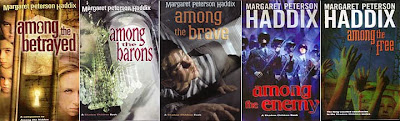
Shadow Children
Once upon a time*, when I was ten or eleven or so, I brought home a book order from school. I had circled the many books I wanted my momma to buy for me, and I was sure we would sit down later and narrow down my selections. And in that book order was a book, Among the Hidden, by an author I had read before, Margaret Peterson Haddix.
"Do you really want this weird book?" momma probably asked me. "It looks strange. The government says you can only have two kids? What kind of weirdo are you, Jayme?"
"But Momma!" I'm sure I argued, "We liked Running out of Time, the weird book about those kids who thought they lived in pioneer days and escaped! And this lady wrote that too! So it must be good!"
"Okay, fine, whatever, you odd child of mine. At least you're reading."
And I was reading. The problem was, Haddix came out with a sequel a few years later. But I was older. I was reading other books. And Among the Imposters was never at the library. And then it was another year and another book, and so on. And I always meant to read the Shadow Children series and never quite made it. I kind of forgot about them until I would see Among the Hidden sitting on my shelf, which wasn't often. I have lots of books.
Yet at CMS, kids are still reading the Shadow Children series. The last one, Among the Free, didn't even come out til 2006. Good thing I wasn't holding my breath. :) But I digress. I was reminded. And so while I was at the library, getting Peter and the Starcatchers, I thought to myself: I should go look at Haddix's section. See what they have of her. And low and behold, they had the whole series. So I got them. And read them. They're children's books and short, so I pretty much inhaled them.
These folks live in a society where, due to the famine a few years back, they have limited the number of children to two per family. But that doesn't stop everyone, and I'm not entirely sure the government has provided adequate birth control. So there are lots of illegal third, sometimes fourth and fifth, children in hiding throughout the country. And that is where the series starts, with Luke, an illegal third child in hiding. Through the course of the series we meet other illegal children and see other problems within this government. But many of these illegals have fake IDs. The end up meeting each other and banding together, hoping that one day they will become free. Hoping they will have the right to exist.
But they were pretty great. I love the concept, I love all books like this. Of course. I like weird books. Lucky for me, they're pretty in right now (ie: Hunger Games). I'm a little worried they're getting ruined (see my next post) but I'm not too concerned. So yeah, go on. Read these books. You'll love 'em!
*some facts have been exaggerated for the enjoyment of the story telling. But the concept of this is completely true: I was a strange child. I read strange books.
Friday, September 2, 2011
The Island
"Which is better - to be born stupid into an intelligent society
or intelligent into an insane one?"
A follow-up to Brave New World, Huxley offers a cross between utopia and primitive-ity for a "sane" society. Island has many of the same themes as Brave New World, but they are dealt with very differently.
Drugs are still used, but they are used to put the society in an enlightened state for the purpose of gaining knowledge. Likewise with the trances, as they are used for hyper-learning. This "sane" society merges the best of the East and West, as well as utilizing the best of technology, science, and religion, as opposed to being slaves to it.
To be completely honest, the book was a little over my head and I will definitely have to re-read it in the future to gain a better understanding.
Wednesday, April 20, 2011
Brave New World
Brave New World
Aldous Huxley
"What man has joined, nature is powerless to put asunder."
This past weekend I read Brave New World by Aldous Huxley. It was on my list of books to read, but I had never actually heard anything about it. It is about a new society based on Ford's assembly line. It reminded me a lot of Orwell's 1984, which was my first distopian novel. Huxley clearly sets the stage for his novel and establishes the rules for this community. I completely understood the setting and became acquainted with the society. In Brave New World, humans do not love, get married, or have children. Babies are made in factories and raised in group homes. They are created by caste, with a certain purpose, role, and even general personality or lifestyle associated with each caste. They purposefully create the Alphas to be superior to the other castes, which reach as low as Epsilons, who they create at a disadvantage, so as they will be content with their lives and their work. The people are not identified by themselves individually, but as members of their caste.
The problem with this society, which Huxley was obviously addressing,is that they are creating people to be content in their distinct situations, but they cannot be content because there is no opposition in their lives. They can never be truly happy because they have never truly known sorrow. The government attempts to circumvent this as they promote promiscuity, "everyone belongs to everyone else," and drug use, the soma, which places the user in an alternate state of being. There is no love, and although the society is conditioned to not need it, they still feel an emptiness. They try to fill this with sexual relations and the soma, but it is not enough. I feel that Brave New World is a reflection of Huxley's time (written in '31), and the fears of the changes by society, but also the need to create a stable society. With a stable society based around Ford's assembly line, we lose what makes us human and I believe that is the point Huxley is trying to make.
I was frustrated with the ending, however, because I felt as though nothing had changed despite the efforts of the characters in the novel. But perhaps the change comes afterwards? This is why I look forward to reading The Island, the third alternative Huxley would have chosen to offer the savage, so I can see a proposed alternative, which is also the option offered to those for whom the traditional society does not work.
Subscribe to:
Posts (Atom)