Showing posts with label Religion. Show all posts

Friday, September 13, 2013

Pilate's Wife

Antoinette May takes the important tale of Christ and Pontius Pilate and puts a spin on it, telling it from a woman, Claudia, Pilate's wife, via her life story. Pilate's Wife is an intellectual read, but once the story is started, it's hard to stop reading. Truthfully, I'm not very knowledgeable about this time period in history, nor do I buy that this is the "true story" of Christ, but it's an interesting theory. Under the genre of historical fiction, I found it a very interesting read. I recommend it to any who enjoy reading about women in history. 4 Stars. 

Thursday, September 5, 2013

The Storyteller

 
The latest Jodi Picoult book, The Storyteller, is not quite a book I would classify as a "Jodi Picoult" book. I'd classify it as a Holocaust novel instead; it is very much unlike all her other works. Picoult tries to make it her own, make it thought provoking, but for me, it's simply a Holocaust novel. The Storyteller is three stories in one, the past, the present, and the allegory. I enjoyed all three aspects, and felt that they could all stand independently, in fact, I would have been fine without the "present" story. Generally, though, I feel that way about all past/present historical fiction novels. 
 
So, I did like it. The characters were real, imperfectly so. The story was compelling. I enjoyed reading it, couldn't put it down at parts. The questions of the novel, "Can you forgive the unforgivable?" and "Where is the line between justice and mercy?" did not impact me on the level I would have liked them to, nor did I bond with Sage since I feel I would have made different choices. And yet, I am not Jewish. My grandmother was not in a concentration camp. A Nazi Officer has not asked me to forgive him. This isn't a realistic question for me. I would like to think one way, but until you're in the situation yourself, can you really know how you would respond? I'm not sure. 
 
The Storyteller is not an original novel, but it is a good read. I highly recommend it. 4.5 Stars.

Sunday, May 19, 2013

The Genesis Secret


Tom Knox's Genesis Secret tells the suspenseful yet intelligent tale of reporter Robert Luttrell. Sent on a supposedly simple assignment about the excavation of Gobekli Tepe in Kurdish Turkey, the oldest remains of human civilization and apparent Garden of Eden. Rob is quickly drawn in to the mystery of Gobekli Tepe, why the locals are resisting the dig, and, ultimately, the death of the lead archaeologist. Back in the UK, a string of brutal murders are being committed and investigated by the Scotland Yard, especially Detective Forrester. Eventually, a connection is made and Forrester and Luttrell must work together to discover the Genesis secret and, more importantly, catch the crazed murderer. 

The Genesis Secret  is a fairly intense read, not one you can necessarily read at the beach or with distractions around, especially at the end. I mean, James Joyce is referenced! It's a good book; though slow to start, once it all starts to come together it gets hard to put down. However, it is rather violent and grotesque and the language is, at times, obscene and responsive to the violence. The characters attempt to be real and relatable, but fall short. I was more captivated by the story line and desire to solve the mystery than the fate of the characters. I enjoyed it, but I didn't love it. 3 & 1/2 stars. 

Monday, March 18, 2013

The New York Regional Mormon Singles Halloween Dance

A few years ago, I took a Mormon Lit class at UVU.  It was a really interesting class and exposed me to new novels. Comedian Elna Baker's The New York Regional Mormon Singles Halloween Dance was not a novel we read in that class, but our professor talked about it to us one day and read us an excerpt.  After hearing Baker's voice come to life via my professor, I had to get my hands on it. 
New York Regional is a hilarious yet touching memoir by a born and bred world-traveling Mormon. Her sense of humor sort of reminds me of Chelsea Handler, but not as crass. So I recommend this book with the caveat Baker uses in her dedication to her parents: " . . . aside from the nine-F words, thirteen Sh-words, four A-holes, page 257, and the entire Warren Beatty chapter . . . You might want to avoid chapters twenty-one, twenty-two, twenty-three . . ." 
Read on! 


Tuesday, February 5, 2013

Incantation

Alice Hoffman's Incantation tells the tale of undercover Jews in Spain during the 1500s.  Our main character, Estrella, doesn't even realize her family is Jewish.  She finally puts the pieces together and sees the danger her family is in.  They have been practicing Judaism but masquerading as good Catholics for years. When they are found out . . . well, it won't be good. At one point, Estrella thinks, "Still, I coudln't help but wonder if it was a mistake for people like us to be tied to a place. If we weren't meant to wander.  If everything we needed was tied up in who we were."  Later, she asks her grandfather a similar question.  He answers, "You run once, what makes you think you won't have to run all the rest of your life?" But if you don't run, will there be a "rest of your life"? 
Incantation is a great historical fiction for the young adult reader.  It delves into history, telling a tale we don't come across too often.  I recommend this novel to all YA Historical Fiction fans. Read on! 

Wednesday, January 23, 2013

The Chronicles of Narnia

After many years from whence I set my mind to it, I finally read The Chronicles of Narnia. It was very interesting to read these works that many have discussed and, actually, debated.  One of the main debates is which order to read them in: how Lewis wrote and published them, or in chronological order, as they are currently published. My copy has all seven in one, and I read them in the order the appeared in this compilation, chronologically. 

One of my reasons for wanted to read Narnia in the first place was because I'd heard it was like a children's bible; a way to present some of the stories and morals from the bible to young children. In fact, when I first read The Magician's Nephew a few years ago, I wrote a paper on it connecting it to Genesis's telling of the creation and the tale of Adam and Eve. It seems to me that Narnia certainly has many links to the bible, but not in an annoying way, more in a teach-your-child kind of way.

Lewis denied allegorical intent in his writing, instead stating that the aspects of Christianity he presented are merely "supposition"1 and I find they're still a great series regardless of their Christian aspect. They're written for younger children, but enjoyable to all ages. I highly recommend this series (even though I didn't like the ending!): just read the books before the movies because they're very different, especially in the battles. Read on! 

1. http://en.wikipedia.org/wiki/Narnia_books  Yes, it's Wikipedia, but I'm quoting a cited source. I just don't know if it's 51 or 52! :) 

Friday, June 22, 2012

When the Black Girl Sings


Bil Wright's When the Black Girl Sings tell the coming of age story of an adopted young black girl. Adoption is the texture, rather than the storyline, but the novel does deal with important issues such as race, religion (but it isn't preachy!), having to make choices, and growing up. 


While well written and teaching a good lesson, When the Black Girl Sings didn't really appeal to me. It just didn't pull me in. I didn't identify with any of the characters. I think I only recommend it to kids who are faced with the same issues the novel deals with. 


Thursday, June 14, 2012

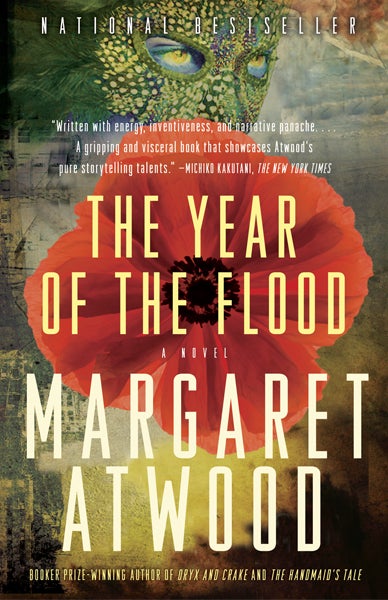
The Year of the Flood

 "So, if you were making the world, you'd make it better?" I said. Better than God, was 
what I meant.  All of a sudden I was feeling pious, like Bernice.  Like a Gardener.  
"Yes," he said. "As a matter of fact, I would."

The Year of the Flood is slated as a sequel to Oryx and Crakeit's really more of a companion novel in my mind. It follows the forward-backward/past&present structure, as well as time frame, of Oryx and Crake with different characters. The Year of the Flood wraps up the cliffhanger of Oryx and Crake, which was very good. It's interesting, however, that when I read Oryx and Crake I wanted it to end one way, but with The Year of the Flood I wanted a different ending, luckily the one Margaret gave me!  

The characters of The Year of the Flood belong to a religious group, almost a cult, called "God's Gardeners." The story is told from multiple points of view of women from the gardeners. I found these characters much more relateable than Jimmy and Crake. Possibly because of their gender. Possibly because of the way it was written. Possibly because they are more relateable. However, the storyline was not as exciting as Oryx and Crake, (because I already knew what was coming?)  but I really like and recommend this novel!

Read on!

Tuesday, January 24, 2012

Sing You Home


Jodi Picoult's latest, Sing You Home, is controversial, same as any other Jodi book.
It deals with miscarriage, IFV, stillbirth.
Divorce.
Embryos as property or people. 
Lesbians.
Religion.
It's all over the place, but so very much together. Jodi was asked why she mixed the topics together, and she said she couldn't see doing them apart. They belonged together.
And in Sing You Home, they most certainly do. 
As always, I feel a little hesitant in recommending Jodi; she's a little risque for the conservative type. I, however, found this one to be not too extreme or explicit.
And, of course, I loved it to death.
Read on!  

Saturday, October 8, 2011

Prophet of Yonwood


The Third Book of Ember, The Prophet of Yonwood, is a prequel, well over 100 years prior to The City of Ember and in the town of Yonwood. A young girl, Nickie, is visiting Yonwood with her Aunt to clean up and sell her great-grandfather's home. Yonwood is the home of a prophet who has seen terrible visions of the future -- war -- and is now in a comatose state. The town is all aflutter trying to follow the visions, trying to follow God, as the verge on fanaticism. They are accusing sinners left and right, and adding new "commandments from God" every time the comatose prophet mumbles something. 

This book was okay. It just wasn't what I was really expecting. It was nothing like the other two books, even for a prequel. And to be honest, I found it pretty irrelevant. It covers the space of a few weeks and then in the last chapter it gives a mini epilogue of sorts for the characters. And then, in one sentence, it is linked to Ember. Maybe in reading the fourth book everything will tie together. I'll let you know!

Saturday, September 10, 2011

Lost Boys

Lost Boys


So I was pretty excited to read this book. It's by Orson Scott Card; I've enjoyed other works of his. He's a pretty good guy. Whatevs. And this is what it says on the back:
"As Stevie retreats into himself, focusing more and more on a mysterious computer game and a growing troop of imaginary friends, the Fletchers' concern turns to terror...And as evil strikes out from the most trusted corners, it's suddenly clear: Stevie's next on the list."
I thought I would love this.
I love creepy books. Ya know, ones that mess with ya. Nothing terrible. Mostly along the lines of Jodi Picoult. 
And then I find out the characters are Mormon. Kind of annoyingly Mormon. They keep having religions discussions throughout the book. And then they give us their formula for how they get new callings. Puke.
And the wife is terribly whiny. She's pregnant and has three other small children. From what I understand that's hard. I also understand that I was the same age as the oldest in the book when my Ma had baby number four. And I don't remember my mom being unable to make dinner or being unaware of what was going on in my life. Yet the wife in this book was totally unable to fulfill her homemaking duties, and is often whining to her husband that he should just quit his job and come home. 
And the book is a bunch of padding & fluff -- lots totally irrelevant to the actual  plot. I just kept waiting for the real story to happen.Waiting and waiting and waiting. 400 pages of waiting!
And then the ending is just terrible. It was almost too real in the emotions and the possibility of my children [who are far off in the future!] being hurt or taken. But at the same time, it was totally ridiculous and impossible. [Spoiler: Ghosts, Spirits, Apparitions, Whatever you want to call it, OF THE DEAD CHILDREN. I didn't buy it.]
And I felt totally creeped out and couldn't sleep. 
I DO NOT RECOMMEND THIS BOOK UNLESS YOU LOVE CREEPY BOOKS. Like, HORROR books full of irrelevant fluff. 
I think this is probably Card's worst work ever. I haven't read everything he's ever written, but I have read a fair sample, and this is a fair assessment. 

Also, I apologize for my ridiculous use of bold. I kind of feel like a teenage girl right now.

Thursday, May 26, 2011

The Virgin Blue


I really didn't like this book!

Okay, that's out of the way. So The Virgin Blue is about this girl, Ella, who moves to France with her husband. Turns out, she's of French descent, but her folks emigrated during the Catholic/Huguenot problems. In stereotypical novel fashion, she starts researching her ancestors, and librarians are more than happy to help her, going out of their way and spending their own time to research her family. The French must be a very helpful people.

Then the novel will flash back to Ella's ancestors. I enjoyed these parts much more, which I have found is generally a problem with this sort of novel. I am always more interested in one of the two stories, usually the historical.  Maybe if it was used more sparingly, as a frame, or a bookend, I would be able to stand it better. 

With these history books, especially Catholic/Huguenot ones, an element of magic is generally present in the women. I'm kind of fascinated by this idea; that men have religion and women have magic. Rephrase: There is a certain mysticism to these women and their rituals, but it isn't like they're casting spells. Just that they believe in a spiritual goddess or female power to help them. This, of course, becomes a major problem for Isabelle, the ancestor, in this book. 

Spoiler: Ella cheats and it bothers me. I don't like her character at all.

And to finish my unclear and scattered review of this book, I feel like Isabelle's story ended quickly and unclearly (whereas she could have an entire novel to herself) and Ella's was unnecessarily drawn out. It was just weird. It got really staccato-y at the end, especially Isabelle's story. I just didn't like it at all. Don't read it.  

Friday, May 20, 2011

Heresies of Nature


"Boy, you and Job and Anne Frank . . . Believing despite the evidence"
Margaret Blair Young

This book tells the story of a 'traditional' Utah family in a not-so-traditional situation.  The oldest daughter has left her husband and the mother  is dying from MS. The father and two girls still at home struggle to take care of the mother and continue on with life.  This book is about choices, struggles, faith, finding faith, losing faith, holding on to it despite everything. This book is about your faith being tried, about having hope for the future.  Its about families and relationships. It's about life and its trials. 

I really enjoyed this novel.  It made me cry a lot-- especially at the end. However, right before I loved it, I hated it terrible. I couldn't understand why people would make such choices, how life could be so hard, why anyone would hurt someone else in that way.  But then it ended. And it was beautiful. It gave me hope.